
Hey there, Bestie! Let’s talk about a super effective tool that might already be in your bag, or quickly added to your toolkit: decoding worksheets. Now, I’m not talking about phonics! As school-based Occupational Therapists, when we talk about “decoding” worksheets, we’re focusing on the incredible visual-motor skills that are absolutely essential for everything from legible handwriting to safe scissor use to math!
These worksheets are like a secret code-breaking mission for your students, helping them to decipher visual information and translate it into precise movements. Ready to understand why these simple pages are about to become your new best friend in therapy sessions? Let’s dive in!
What are “Decoding Worksheets” in the OT World?
In school-based OT, “decoding worksheets” refer to activities that require a student to visually analyze lines, shapes, and patterns, and then reproduce them accurately with their hands. Think beyond just simple tracing. These activities challenge a child to:
- Visually track a specific line (straight, curved, zig-zag).
- Discriminate between different lines or shapes.
- Plan the motor movements needed to follow or create that line.
- Execute the motor pattern with precision.
They often involve following paths, completing mazes, connecting dots to form shapes, or cutting along increasingly complex lines.
Why These Worksheets Are Your New Bestie
These seemingly simple worksheets are powerhouse tools for developing foundational skills that directly impact a student’s success in the classroom.
- Fine Motor Precision & Control: As students carefully guide their pencil or scissors along a line, they’re refining the tiny muscles in their hands and fingers. This builds the precision needed for intricate tasks like buttoning, zipping, and manipulating small objects.
- Visual Motor Integration (Eye-Hand Coordination): This is the big one! Decoding worksheets are a direct workout for the connection between the eyes seeing information and the hands responding to it. This “eye-hand teamwork” is crucial for copying from the board, tracking text while reading, and staying on the lines when writing.
- Motor Planning: Before a student even puts pencil to paper or opens their scissors, their brain needs to plan the sequence of movements. These worksheets provide structured practice for this motor planning, helping children internalize the steps for forming letters or cutting shapes.
- Handwriting Readiness: These sheets lay essential groundwork. They help students master pre-writing strokes (vertical, horizontal, circles, crosses, diagonals) and understand spatial concepts like staying within boundaries—all directly transferable to forming legible letters and numbers.
- Scissor Skills Development: For cutting tasks, decoding worksheets are invaluable. They teach a child to visually follow a line while simultaneously managing the open-and-close motion of scissors and guiding the paper. Starting with straight lines and progressing to curves and angles builds confidence and control.
- Attention & Focus: The engaging nature of many decoding activities can help improve sustained attention and task persistence, as students concentrate on completing the visual challenge.
How They Translate to Real-World School Skills
The skills honed with decoding worksheets aren’t just for the therapy room; they directly impact a student’s ability to participate and succeed in everyday school tasks:
- Writing: From staying on the line to forming consistent letters, visual motor skills are paramount.
- Cutting: Safely and accurately cutting out shapes for projects, or even opening packages.
- Drawing & Art: Reproducing shapes, following instructions for art projects.
- Math: Graphing, aligning numbers, using rulers.
- Classroom Independence: Organizing materials by understanding visual cues.
Ready to Help Your Students Decipher Success?
Don’t underestimate the power of these targeted visual-motor activities! Incorporating decoding worksheets into your sessions provides foundational skill-building that makes a tangible difference in a student’s educational participation. They’re a simple, effective way to help children unlock their full potential.
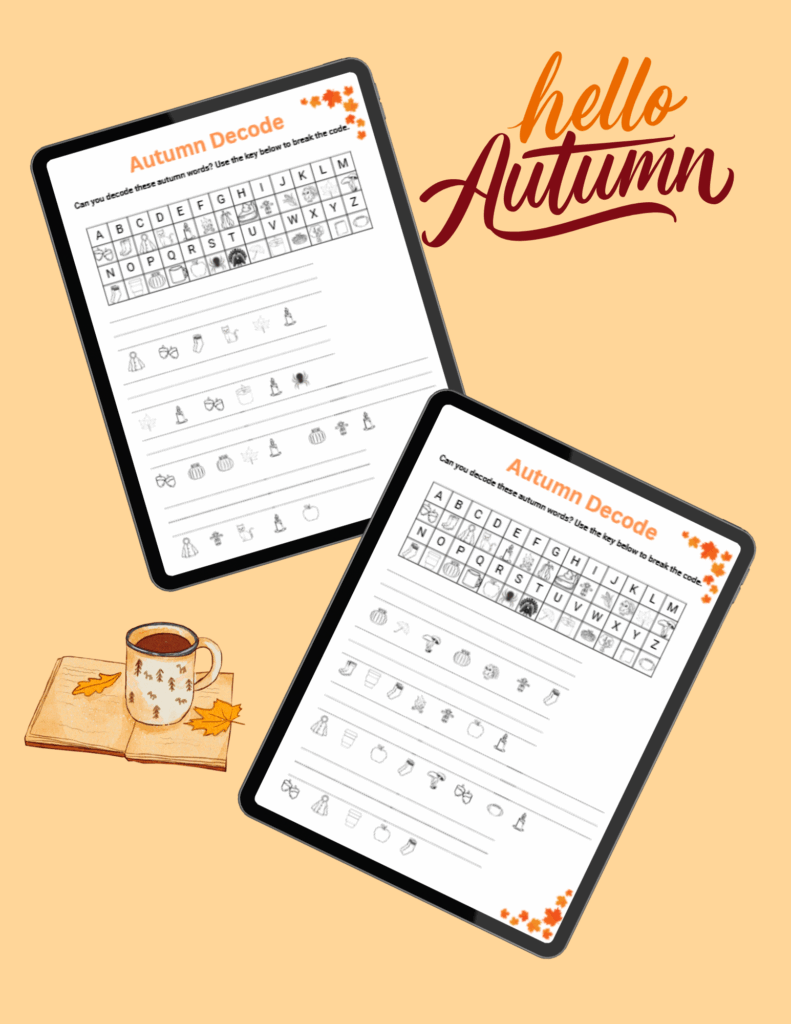
Looking for ready-to-use resources to boost these crucial skills? Our autumn decoding worksheets are Free here!